
Wheel alignment makes sure your tires are perpendicular to the ground and parallel to each other. When the wheels are aligned correctly, your car drives straight and your tires wear evenly. On vehicles with Advanced Driver Assistance Systems (ADAS), an alignment often also calls for special procedures so the active safety systems are ready to do their job.

Why Wheel Alignment Matters
- Improved safety: misaligned wheels can make your car pull to one side, making it harder to control.
- Fuel efficiency: properly aligned wheels take less energy to roll, which can help fuel economy.
- Longer tire life: uneven tire wear is one of the most obvious signs of misalignment.
- Smoother ride: good alignment helps reduce vibration and road noise.
- Less suspension wear: misalignment puts extra stress on suspension parts.
A common guideline is to have the alignment checked every 12,000 to 15,000 miles or at least once a year, and whenever you install new tires, notice unusual tire wear or handling, or hit a pothole or curb.
Camera and Radar Calibration After an Alignment

Often the camera systems need recalibration after an alignment, and so do radar sensors. Sensors that support Automatic Emergency Braking (AEB) and Adaptive Cruise Control (ACC) typically need a special procedure so they can perform optimally.

See our ADAS calibration services for more on these procedures.
Tesla Wheel Alignments Done Properly
Even a brand-new vehicle may not have its alignment exactly where it should be. On one client’s 2022 Tesla Model Y, the car’s own data showed a 2.2° applied steering offset because the wheels weren’t properly aligned. Left alone, that can mean premature tire wear and handling that isn’t what it should be.
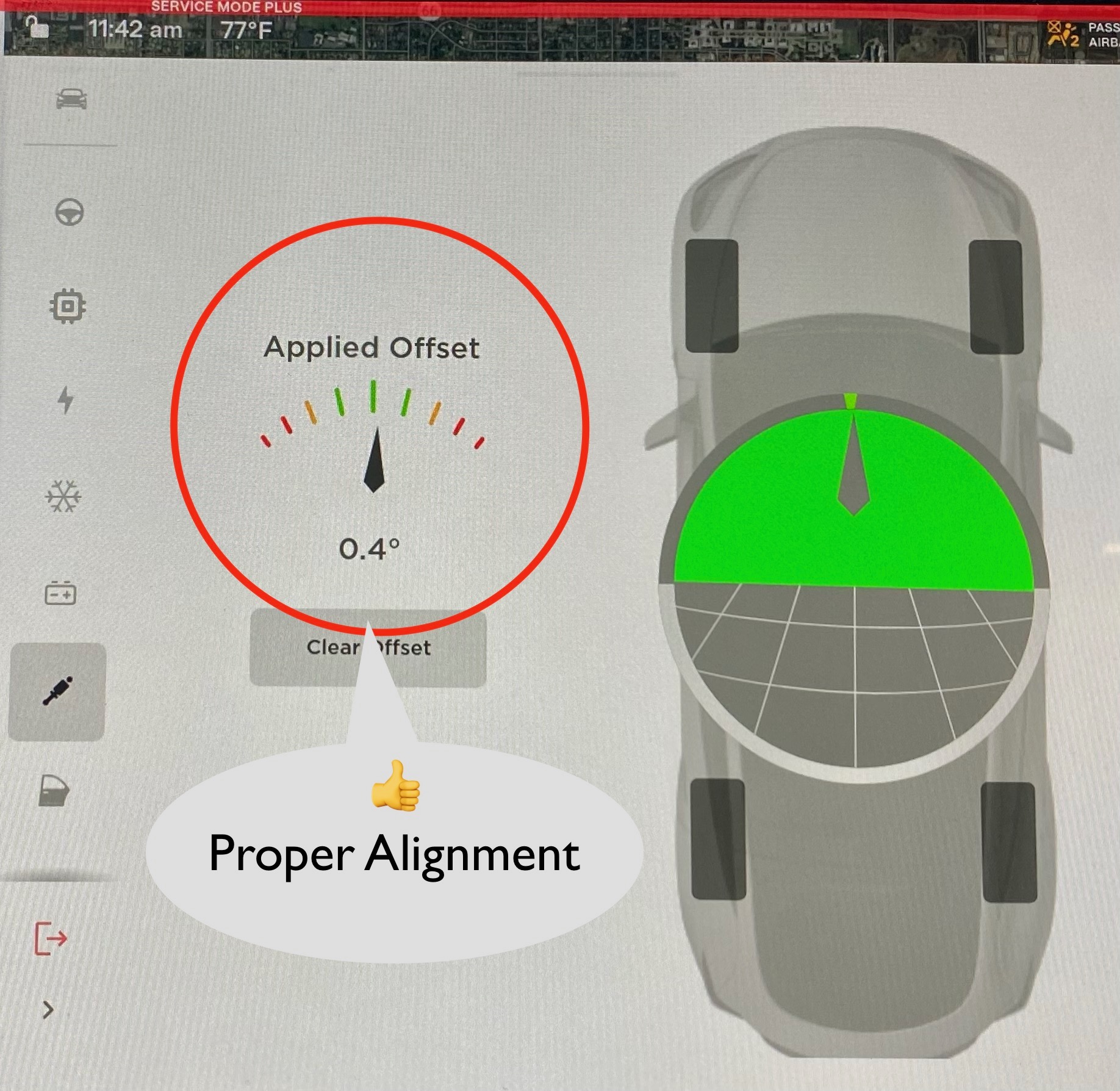
Tesla recommends that the vehicle be properly loaded so ride height is correct for the alignment. We use ballast bags to reach Tesla’s recommended 300 lb load and the proper trim height. Skipping that step works against a proper Tesla alignment.

Free Tesla alignment check: mention this post, and we’ll check your Tesla’s alignment data for free using Tesla Service Mode to see whether it needs an alignment.
After the alignment, the technician clears the applied offset and performs a road test long enough for the vehicle to learn the new offset. If everything works as planned, the new applied offset should be under 1°.
Abnormal Tire Wear

Uneven tire wear is one of the clearest signs of misalignment. Once a proper alignment is performed, the suspension and steering geometry are in position to deliver the handling and tire life the vehicle was designed for.
Wheel Alignment FAQ
How often should I get a wheel alignment?
A common guideline is every 12,000 to 15,000 miles or once a year, and any time you notice uneven tire wear or handling problems, install new tires, or hit a pothole or curb.
Why does my car need a calibration after an alignment?
On vehicles with ADAS, cameras and radar sensors use the vehicle’s direction of travel as a reference. After alignment changes, many vehicles need a camera or radar calibration so those systems perform as designed.
Do you offer a free Tesla alignment check?
Yes. Mention this post, and we’ll check your Tesla’s alignment for free using Service Mode.
Is a Tesla alignment different?
Tesla recommends the vehicle be properly loaded for the alignment so ride height is correct. We use ballast bags to reach Tesla’s recommended 300 lb load, then clear the steering offset and road test so the car relearns it.
Book a Wheel Alignment in Claremont
Connie & Dick’s in Claremont can perform a proper wheel alignment, including Teslas and vehicles that need ADAS calibration. Call us or book online today.
Connie & Dick’s Auto Service · 150 Olive Street, Claremont, CA · 909-626-5653
Related: Wheel alignment · ADAS calibration services · Tesla service · ADAS maintenance
Recent Comments