
Another shop brought a 2017 Toyota Tacoma with the 3.5-liter 2GR-FKS engine to Connie & Dick’s Auto Service in Claremont and asked for diagnostic help. The truck felt down on power. There was no relevant diagnostic trouble code, and idle could look normal.
This is also the kind of work we do as diagnostic consultants for other shops: measure the complaint, explain what the data shows, and recommend a path. We were not the shop performing the repair on this Tacoma. This write-up is about the diagnosis, not a confirmed fix.
First look: lack of power, and a question
Our first look showed the lack of power. A useful way to think about this job is that spark timing equals torque. When ignition timing is pulled sharply negative, the engine makes less torque — and that is what you feel on tip-in.
We captured that symptom with HP Tuners. On launch, with the pedal at about 88 percent, spark timing dropped from about 12° to about −4°. The short replay below shows that capture.
That first look made the lack of power visible. It also raised the question we had to answer next: why was timing being pulled?
Then we went to Toyota Global Techstream
To see what else we could uncover, we moved to Toyota Global Techstream (GTS+). On tip-in, we recorded live data and looked at the signals that belong together: intake cam target, intake cam actual, ignition timing, and knock feedback.
AI helped us read the log. The technician made the calls.
We exported the GTS+ data log to a CSV file and used one of our AI agents to help analyze it. The AI was a tool, not a replacement for the diagnosis. It helped us identify problem areas and understand more about why the spark sum — the total spark advance — was so negative. The technician reviewed that analysis and made the calls.
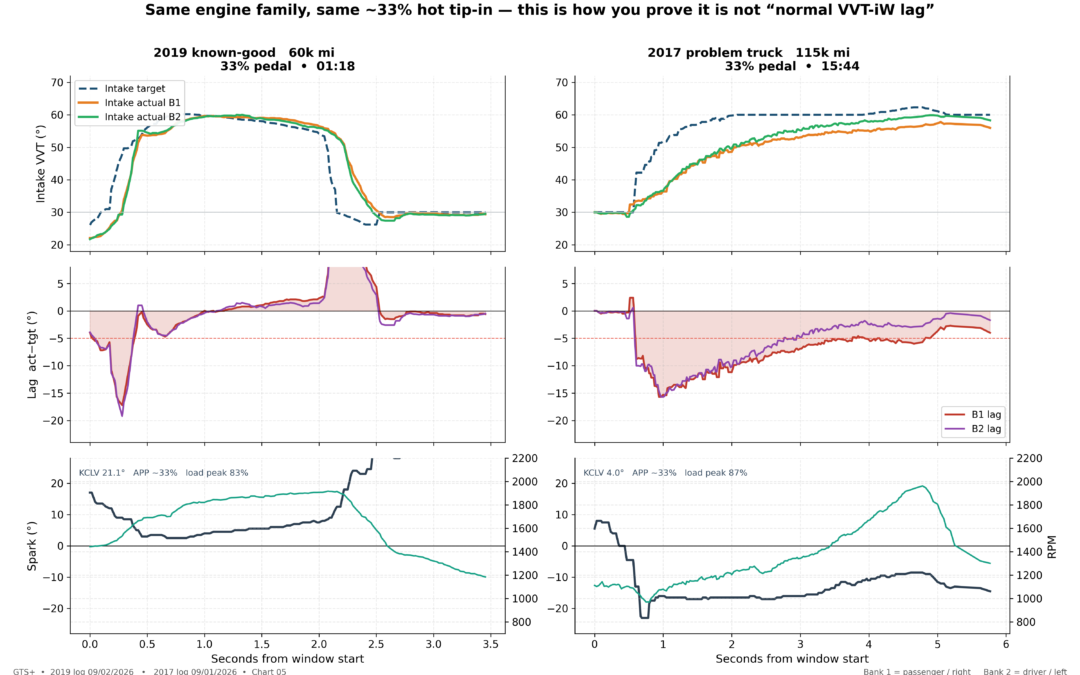
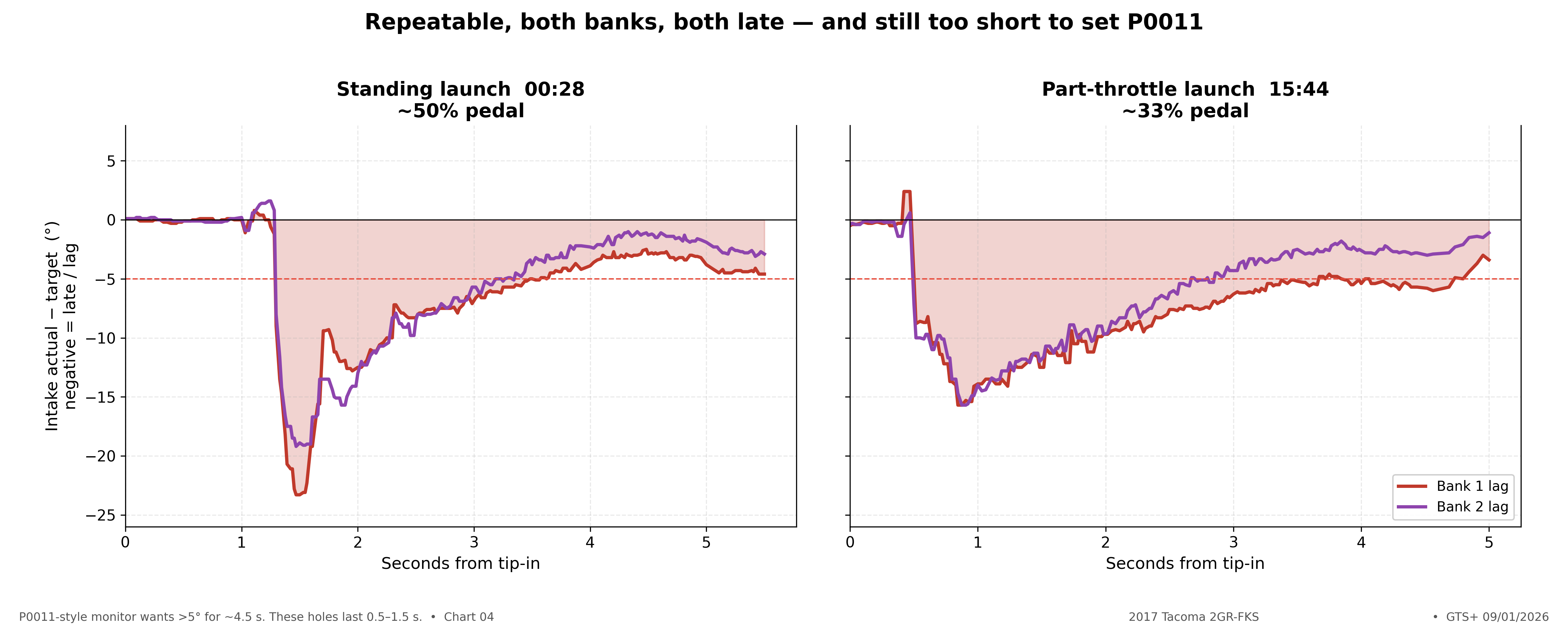
What the data pointed to was intake cam timing lagging its target on both banks. At the start of a tip-in, intake timing was still sitting at the hold position while spark had already been pulled back. That combination is why the truck felt dead immediately. The lag was repeatable, and it was short — long enough for the driver to feel, and too short for a typical P0011 cam-timing monitor to set a code. This was not a knock event: knock feedback stayed parked while spark went negative.
A known-good comparison backed up the theory
To further reinforce that theory, we compared the data with another truck: a known-good 2019 Tacoma with the same engine family, captured the next day on a similar tip-in.
On the known-good truck, intake actual tracked its target and spark stayed positive. The comparison helped explain both sides of the complaint: why this Tacoma performed so poorly, and why it never set a fault code. A brief leave-hold can be normal on this engine family. Staying late is not.
General background: P0011 is a camshaft timing monitor. In general, that kind of monitor does not set a code for every brief error. It typically needs the difference between commanded and actual cam position to stay outside a limit for several seconds. A short hole can feel like a missing engine and still never satisfy the monitor. No code does not mean no problem.
What the findings pointed to — and what we are not claiming
The findings pointed to the intake cam phasers and related components, not a parts guess from a code list.
That is where this story stops on purpose. Another shop was handling the vehicle. The case is still open, and we do not have after-repair data. We are not saying the work was completed, and we are not reporting a result.
Connie & Dick’s does this diagnostic work for our own customers, and we also provide diagnostic consulting for other shops that want help pinning a difficult complaint down before more parts go on the vehicle.
If your Toyota feels down on power — especially if there is no check engine light — or if you are a shop that needs diagnostic assistance, contact Connie & Dick’s in Claremont. Call 909-626-5653 or use the chatbot on connieanddicks.com. When we perform repairs, our warranty covers parts and labor nationwide.
Recent Comments