
A 1995 Chevy Corvette came into our Claremont shop running poorly intermittently. Intermittent drivability problems on classic cars can be hard to pin down, and owners of these cars know how many parts can be suspects.
The Symptom: Running Poorly, On and Off
The car ran fine some of the time and cut out at other times, which is exactly the kind of complaint that tempts a shop to start swapping parts.
What We Tested
We put the oscilloscope on the ignition system and watched the secondary ignition, the high-voltage side that delivers spark to the plugs. We looked at it under different conditions: at light load, and on a quick snap of the throttle.
General background: The Opti-Spark is the distributor used on GM LT1 and LT4 engines of this era, including the C4 Corvette. It sits at the front of the engine and distributes spark to each cylinder. Like any distributor, it relies on insulation to keep high voltage going where it should. If that insulation breaks down, voltage can find another path.
General background: Testing under load matters. When the engine is asked to accelerate, the ignition generally needs more voltage (kV) to fire the plugs. A weak spot in the system may look fine at idle and only fail when that demand rises.
What the Scope Showed
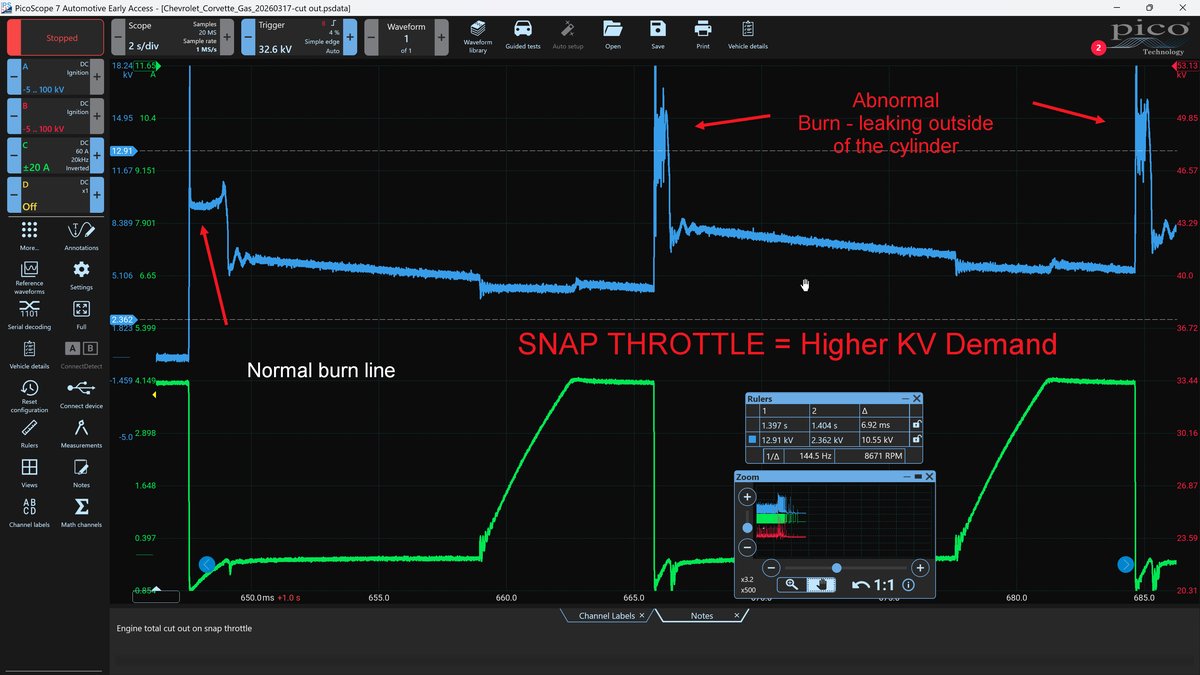
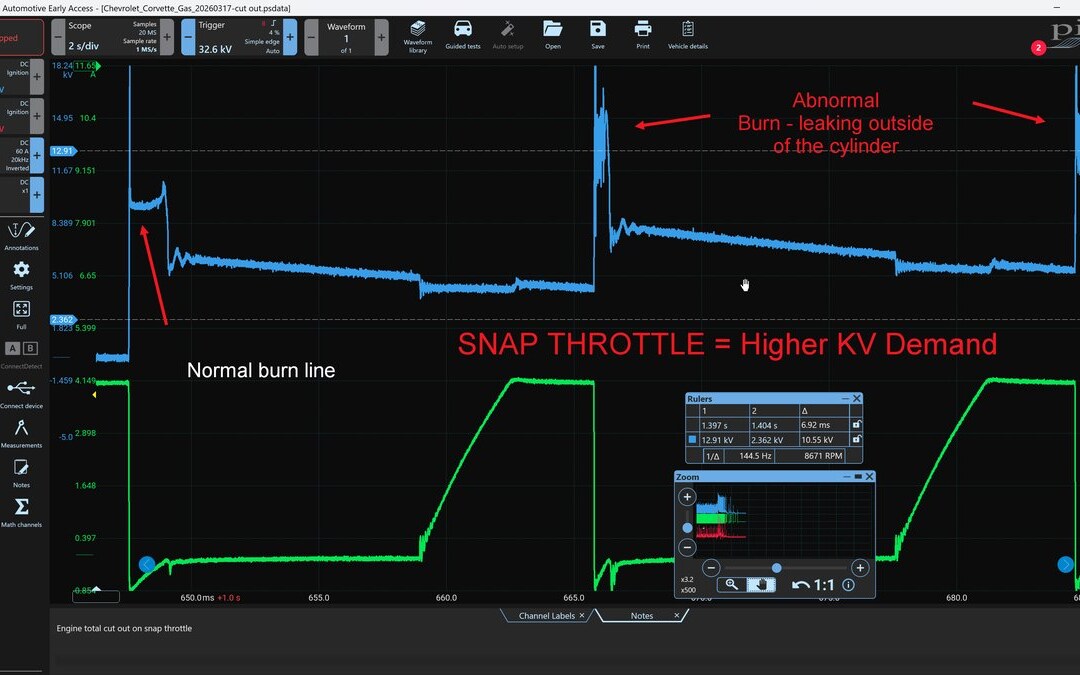
The scope revealed secondary insulation breakdown inside the Opti-Spark:
- At light load: the burn line looked normal. The spark appeared to be doing its job.
- On a snap throttle: with higher kV demand, the spark began leaking outside the cylinder, and the engine cut out.
That’s the intermittent problem caught on screen. It only showed up when the ignition was asked for more voltage, which explains why the car ran poorly on and off rather than all the time.
The Fix
The scope pointed to the Opti-Spark itself as the source of the problem, and we installed a new Opti-Spark. This is a classic Opti-Spark failure mode, and the waveform shows it clearly.
Watch a PicoScope catch Opti-Spark high-voltage leakage in this short video.
Why Testing Beats Guessing
On a classic car, throwing parts at an intermittent problem gets expensive fast, and some parts are harder to source than others. Without a test, it’s easy to replace plug wires, coils, or sensors and still have a car that cuts out.
The oscilloscope, part of our engine diagnostics, lets us:
- Test the ignition under the conditions where it actually fails.
- See exactly when and how the spark leaks.
- Identify the failed component before anything is replaced.
The scope shows it instead of throwing parts at it.
Corvette Opti-Spark FAQ
What is an Opti-Spark?
In general, it’s the distributor GM used on LT1 and LT4 V8 engines in the 1990s, including C4 Corvettes. It distributes high-voltage spark to each cylinder.
Why does my car only run badly sometimes?
Some ignition faults only show up when the system needs more voltage, such as when accelerating. On this Corvette, spark leaked only on snap throttle.
Can I see what Opti-Spark leakage looks like on a scope?
Yes. The short video “GM Opti-Spark HV Leakage Diag via Picoscope” shows it: youtube.com/shorts/2OO7KFWEVaA
Do you work on classic cars?
Yes. Whether you drive a Corvette, a classic, or a daily driver, we test before we replace.
Schedule a Classic Car Diagnosis in Claremont
Classic car running poorly on and off? Connie & Dick’s Auto Service in Claremont tests before we replace. Call us to schedule your diagnosis.
Connie & Dick’s Auto Service · 150 Olive Street, Claremont, CA · 909-626-5653
Related: Engine & OBDII diagnostics · Vehicle service · Case study: Toyota Sequoia misfire
Recent Comments