
A 2006 Mercedes-Benz was towed into our Claremont shop with a no-start. The next day, it ran and drove fine.
The Symptom: Towed In, Then Ran Fine
That’s one of the most frustrating situations for a driver, and one of the hardest for a shop. If the problem isn’t happening when the car is in the bay, a quick look might find nothing at all. Intermittent problems like this are exactly where an oscilloscope earns its keep.
What We Tested
We used our PicoScope to watch the signal from the crankshaft position (CKP) sensor.
General background: The CKP sensor tells the engine computer how fast the crankshaft is turning and where it is in its rotation. The computer uses that signal to time spark and, on many engines, fuel injection. Without a good crank signal, the engine may not know when to fire, so it can stall or refuse to start.
What the Scope Showed
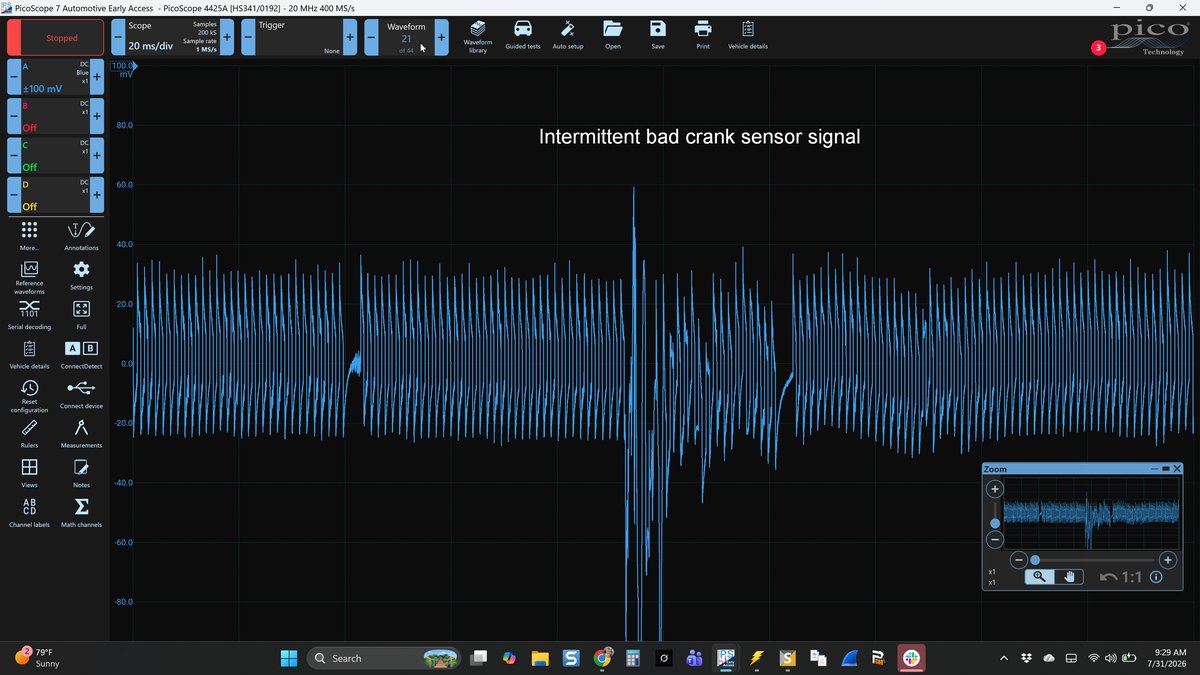
The scope captured unusual, intermittent output from the CKP sensor. A healthy sensor produces a steady, repeating pattern. When that pattern drops out or goes irregular even briefly, it can be enough to cause a stall or no-start.
General background: A one-time code check can miss faults like this. If the fault is brief, it may not set a code, or the code may not point clearly to the cause. A scope shows the signal itself in real time, which is why it can catch problems that come and go.
The Fix
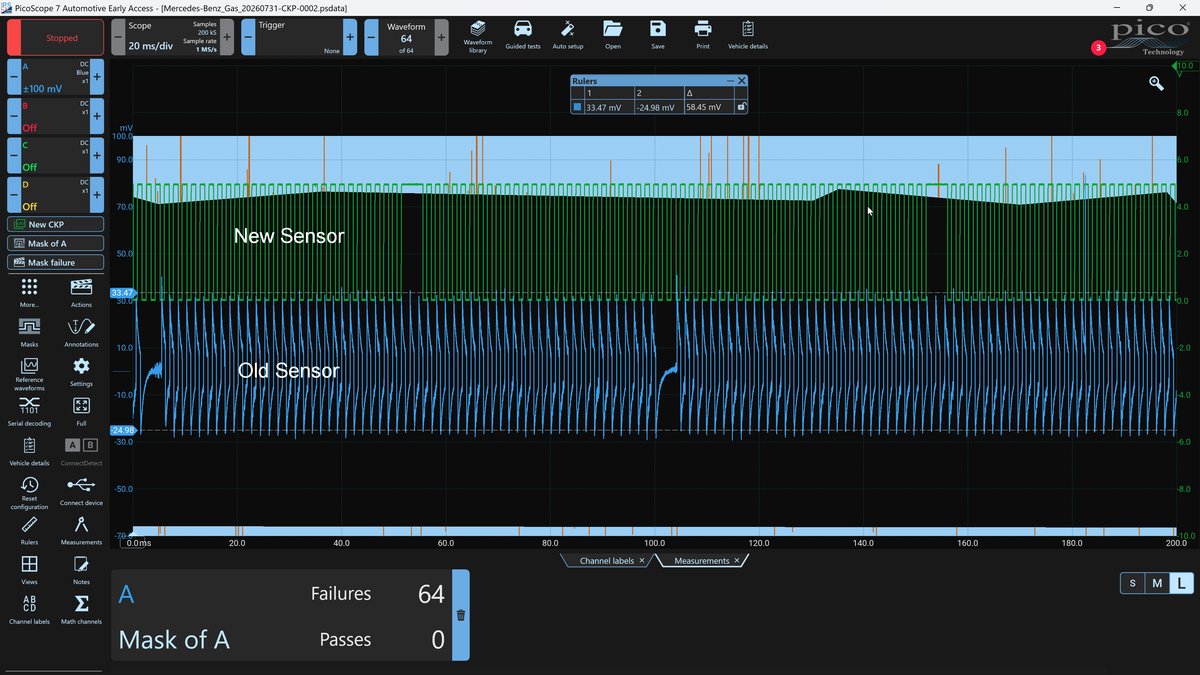
We replaced the crankshaft position sensor with a new CKP sensor. We then compared the new sensor’s signal with the old one on the scope, giving a direct look at the difference between the faulty output and a healthy one.
Why Testing Beats Guessing
With an intermittent no-start, guessing is expensive. Many parts can play a role in whether an engine starts, and without seeing the problem, it’s easy to replace several and still not fix it.
Testing lets us:
- Catch a fault that only happens some of the time.
- Identify the specific component producing a bad signal.
- Compare the old and new parts to confirm the repair.
That’s how a car that “runs fine now” gets fixed for good instead of coming back on a tow truck.
Mercedes No-Start FAQ
What does a crankshaft position sensor do?
In general, it tells the engine computer crankshaft speed and position so it can time spark and fuel. When it fails, the engine can stall or not start.
Why would my car not start, then start fine the next day?
Intermittent problems can come from a component that fails only some of the time. On this Mercedes, the scope found intermittent crank sensor output.
Can you diagnose a problem that isn’t happening right now?
Often, yes. An oscilloscope can capture brief signal faults that a one-time code check can miss.
Get an Intermittent No-Start Diagnosed in Claremont
If your car won’t start some of the time, or started fine after a tow, call Connie & Dick’s Auto Service in Claremont today. Call us or book online to schedule a diagnosis.
Connie & Dick’s Auto Service · 150 Olive Street, Claremont, CA · 909-626-5653
Related: Engine & OBDII diagnostics · European vehicle repair (BMW) · Vehicle service · Case study: Subaru slow crank
Recent Comments