
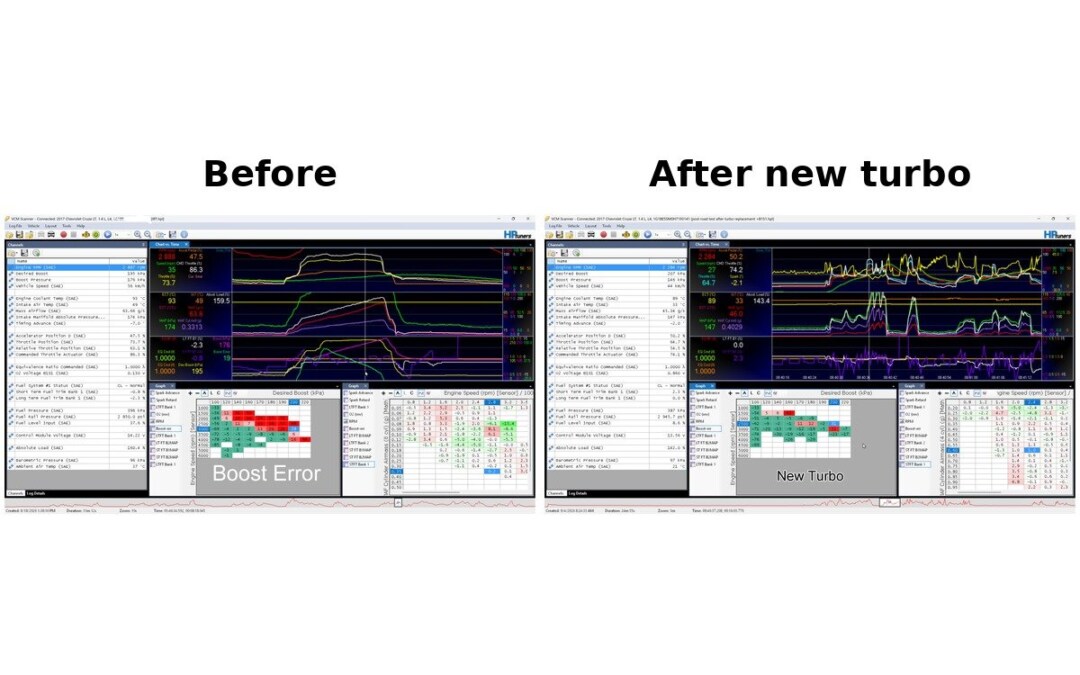
A 2017 Chevy Cruze LT with the 1.4L turbo came into our Claremont shop with code P0299 stored.
The Symptom: Code P0299
General background: P0299 means “turbocharger/supercharger underboost.” In plain terms, the engine computer asked for a certain amount of boost pressure and didn’t get it. In general, the code itself doesn’t name a failed part. Underboost can come from several places in a turbo system, which is exactly why reading a code isn’t the same as diagnosing it.
What We Tested
We logged live data with an HPTuners VCM Scanner and compared desired boost (what the engine wants) with actual boost (what it’s getting).
General background: A data log records many sensor values over time while the vehicle is driven. For a boost complaint, the most useful comparison is commanded versus actual. If the two track together, the system is doing its job. If actual falls short of desired under load, the logs show where and how much.
What the Scan Data Showed
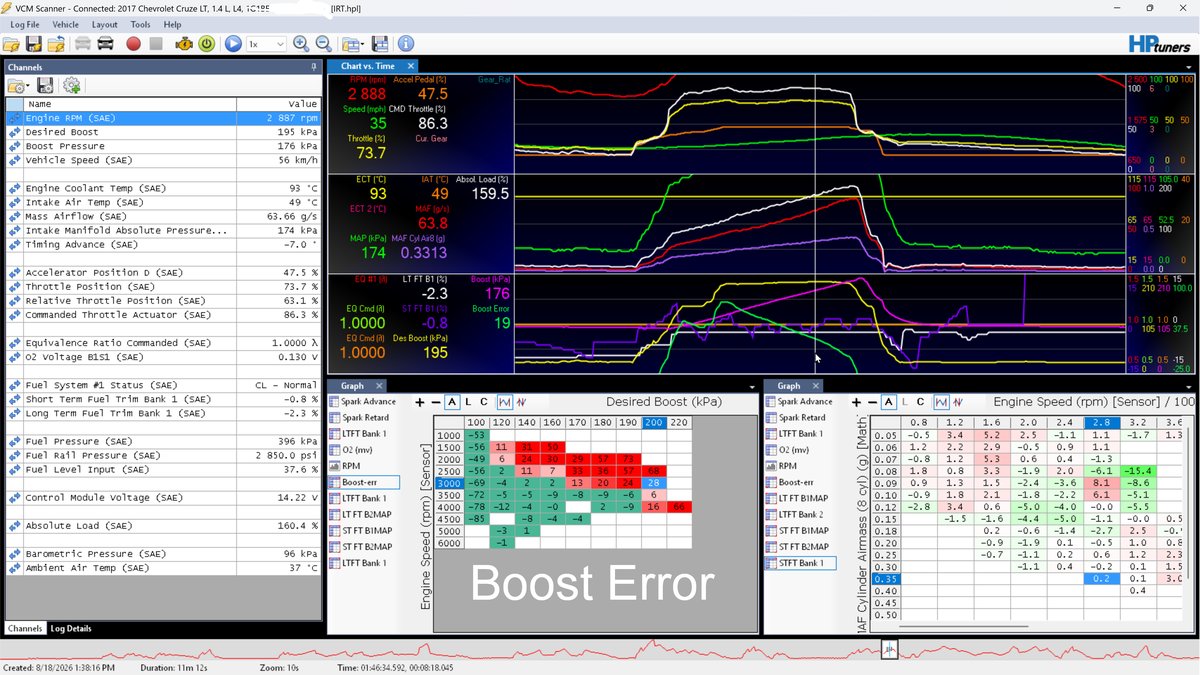
The before log made the problem clear:
- At around 2888 RPM and 35 mph, the engine wanted about 195 kPa of boost but was only getting about 176 kPa.
- The Boost Error map lit up with red underboost cells, showing the shortfall wasn’t a one-time blip in the log.
That gave us a measured underboost condition, not just a stored code.
The Fix
The repair was a new turbocharger. After the repair, we ran a road test and logged it again. The after-repair log validated the fix.
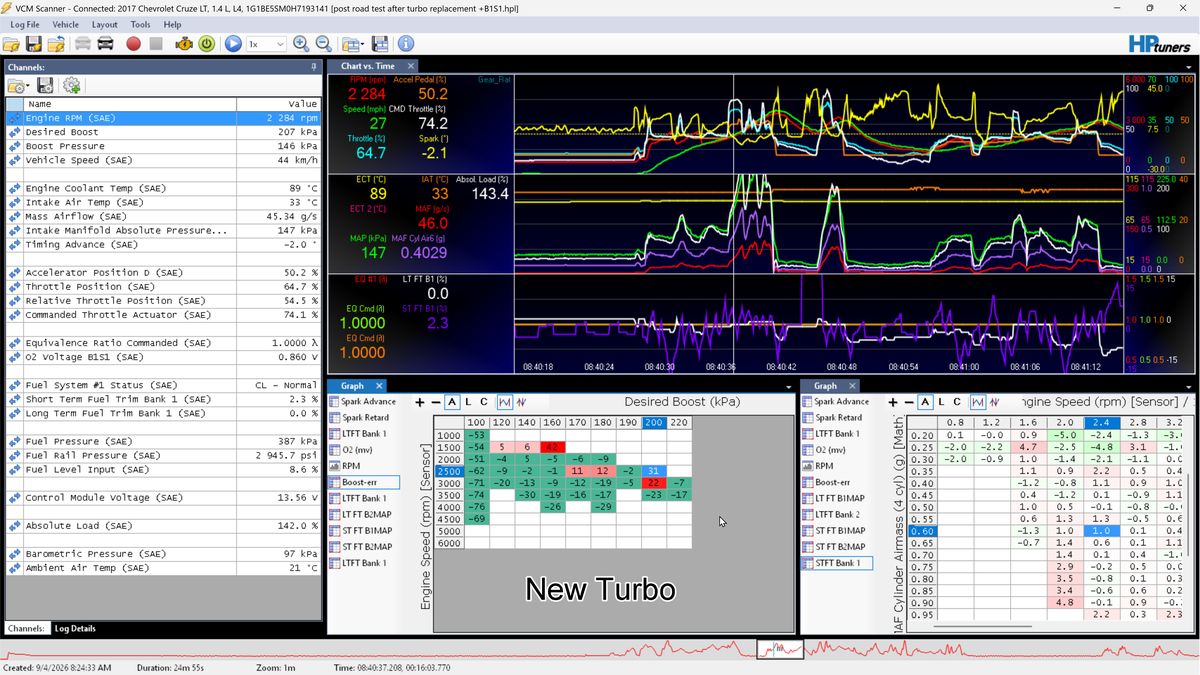
This is the part of the job many shops skip. Logging after the repair means we’re not hoping the problem is gone; we’re showing it with the same data that identified it.
Why Testing Beats Guessing
Turbo systems are expensive to guess on. A turbocharger is a significant part, and in general there are other components in the boost system that can also cause low boost. Replacing parts without evidence can mean paying for repairs that don’t fix the problem.
With data logging as part of our check engine light diagnostics, we:
- Confirm the underboost condition under real driving.
- Measure how far actual boost falls short of desired.
- Validate the repair with a before-and-after comparison.
Data before and after means we know the repair worked before the car goes home.
P0299 FAQ
What does code P0299 mean?
It means turbo or supercharger underboost: the engine isn’t making the boost pressure it’s asking for.
Does P0299 always mean the turbo is bad?
Not necessarily. In general, several parts of the boost system can cause underboost. That’s why we log and compare desired versus actual boost before recommending a repair.
How do you know the repair worked?
We road test and log the data again after the repair, then compare it with the before log.
Book a Turbo or Check Engine Light Diagnosis in Claremont
If your turbocharged car has a check engine light or feels down on power, book a diagnostic visit with Connie & Dick’s Auto Service in Claremont. Call or book online today.
Connie & Dick’s Auto Service · 150 Olive Street, Claremont, CA · 909-626-5653
Related: Check engine light & OBDII diagnostics · Vehicle service · Case study: Toyota Sequoia misfire
Recent Comments