
Does your Subaru crank slowly when you try to start it? It may feel like the battery is weak. But it could be a bad starter. We’ve seen many of these at our Claremont shop, and we have specific tests that can pin down the source.
The Symptom: Slow Cranking
This 2019 Subaru Forester is a good example: it cranked slowly, the classic “weak battery” feeling.
What We Tested
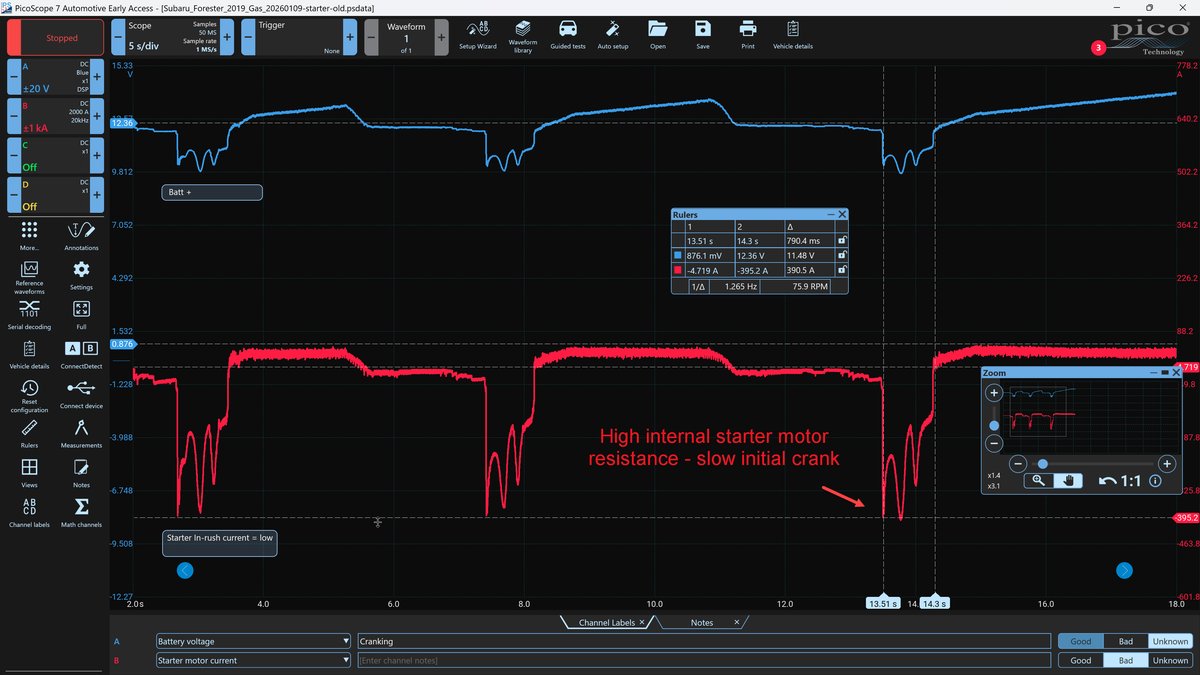
Before condemning the starter, we tested the battery separately. Then, using the oscilloscope, we monitored in-rush current over voltage while the engine cranked.
General background: When you turn the key, the starter motor draws a big surge of current from the battery to begin turning the engine. That initial surge is the in-rush current. Watching current alongside battery voltage helps separate a battery problem from a starter problem. In general, a battery issue tends to show up as voltage that can’t hold up, while a starter with high internal resistance can’t draw the current it should, even when the battery supplies it. A scope also lets us estimate cranking speed from the waveform.
What the Scope Showed
With the original starter:
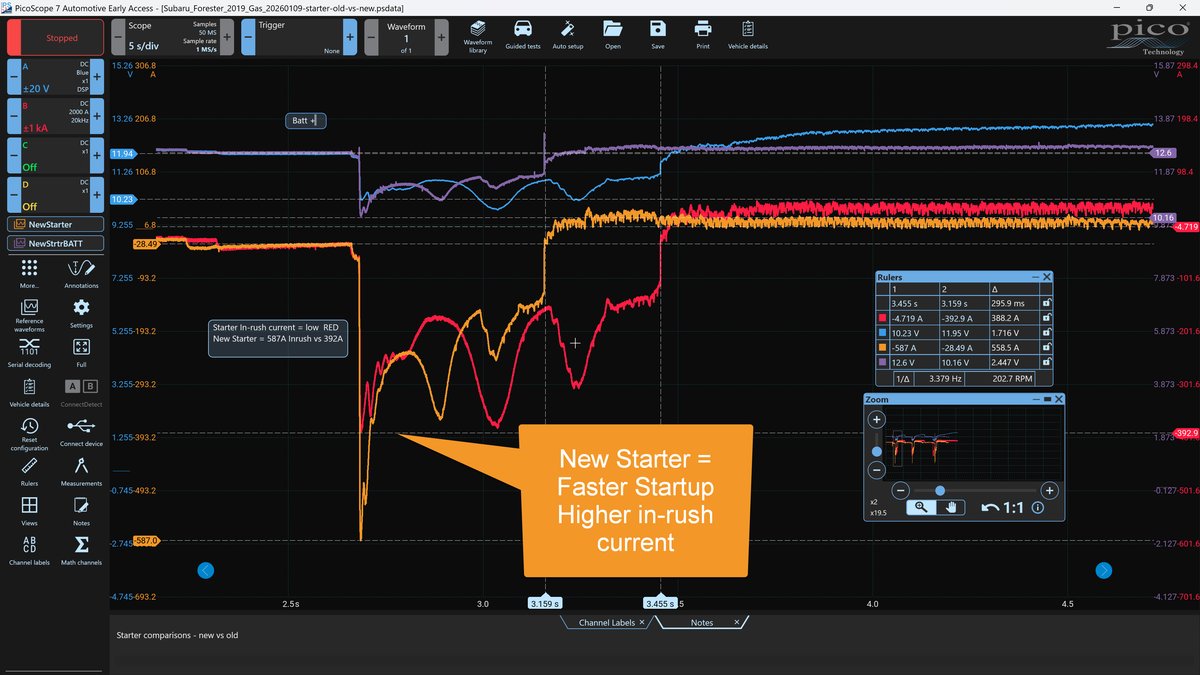
- In-rush current was only about 392 amps.
- The engine cranked noticeably slowly.
That combination points to high resistance inside the starter. The motor simply couldn’t pull enough current to spin the engine at a healthy speed.
The Fix
We replaced the starter. With the new starter:
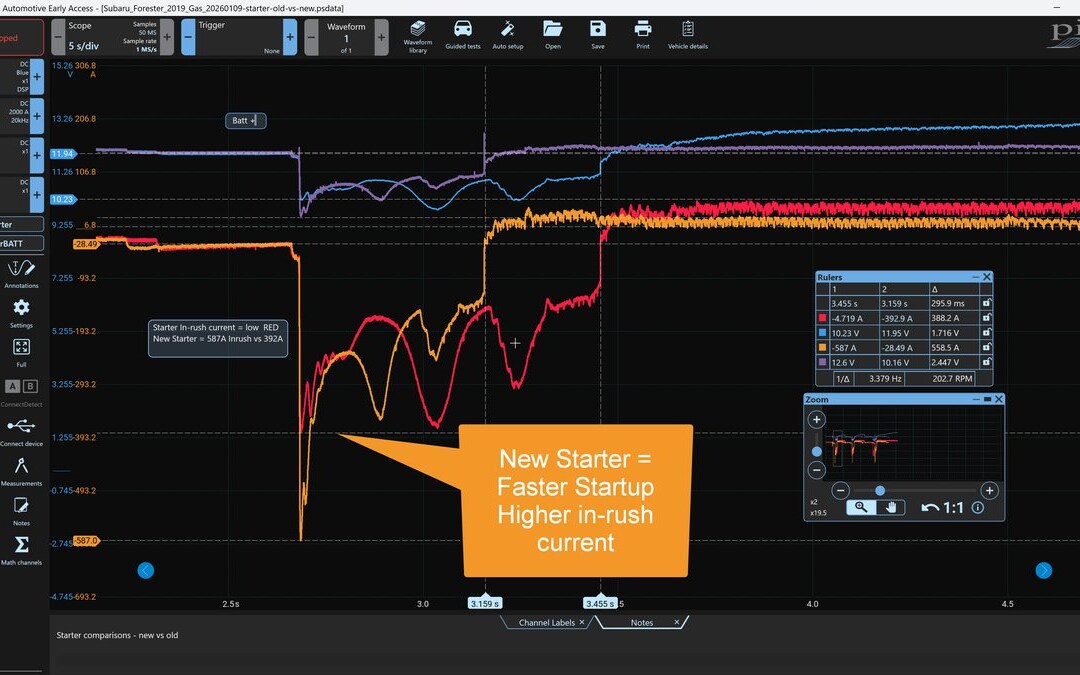
- In-rush current rose to about 587 amps.
- The engine started much faster.
Same battery, much better start. The before-and-after comparison confirms the repair.
Why Testing Beats Guessing
Slow cranking is often blamed on the battery, and many drivers replace it first. If the real problem is the starter, a new battery doesn’t fix it, and the slow crank comes back.
Testing in-rush current over voltage lets us:
- Tell the difference between a weak battery and a starter problem.
- Measure how the starter is actually performing.
- Confirm the repair with a before-and-after comparison.
Specific tests like this find the real cause so you don’t pay for parts you don’t need.
Subaru Slow Crank FAQ
Why does my Subaru crank slowly?
A weak battery is one possibility, but a starter with high internal resistance can cause the same feeling. On this Forester, the starter was the cause.
How do you test a starter versus the battery?
We use an oscilloscope to monitor in-rush current over voltage while cranking, which shows whether the starter is drawing the current it should.
Will a new battery fix slow cranking?
Only if the battery is the problem. If the starter is at fault, the slow crank can continue with a new battery.
Book a Starting and Charging Check in Claremont
If your Subaru or any vehicle cranks slowly, book a starting and charging check with Connie & Dick’s Auto Service in Claremont. Call us or book online today.
Connie & Dick’s Auto Service · 150 Olive Street, Claremont, CA · 909-626-5653
Related: Vehicle service · Vehicle inspections · Engine & OBDII diagnostics · Case study: Mercedes intermittent no-start
Recent Comments