
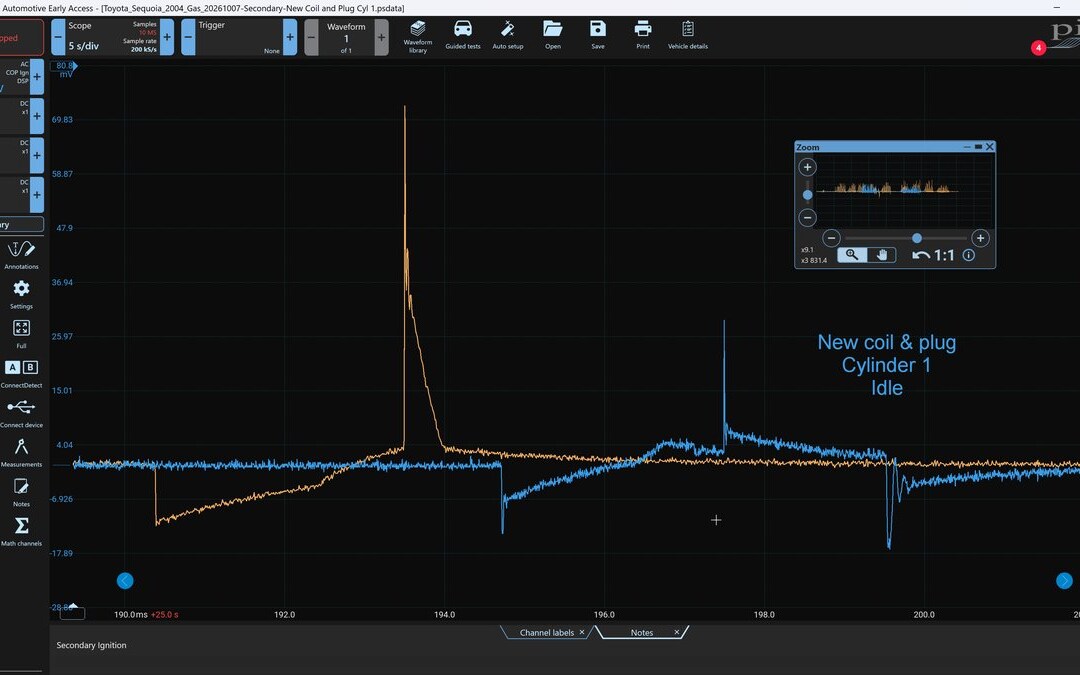
A 2004 Toyota Sequoia came into our Claremont shop with a misfire. A misfire is one of the most common drivability complaints we see, and it is also one of the easiest to misdiagnose. A misfire can have more than one possible cause, so we test instead of guessing.
The Symptom: A Misfire
General background: A misfire happens when a cylinder doesn’t burn its air-fuel charge properly. In general, the cause can be ignition (spark plug, coil, or the path the spark takes), fuel delivery, or mechanical issues such as compression. A check engine light and a misfire code can tell you that a cylinder is misfiring, but they don’t tell you why. That “why” is the difference between a one-visit repair and a parade of parts.
What We Tested
We connected our PicoScope oscilloscope to the ignition system and looked at the secondary ignition pattern. The secondary side is the high-voltage part of the system: the voltage the coil produces and delivers to the spark plug.
General background: An oscilloscope draws voltage over time as a picture, called a waveform. For ignition, the waveform shows how much voltage it takes to fire the plug and how long the spark burns afterward (the “burn line”). A healthy cylinder has a recognizable shape. When something is wrong, such as spark leaking to ground somewhere it shouldn’t, the shape changes in ways a technician can read.
Rather than looking at one pattern in isolation, we compared secondary ignition patterns side by side.
What the Scope Showed
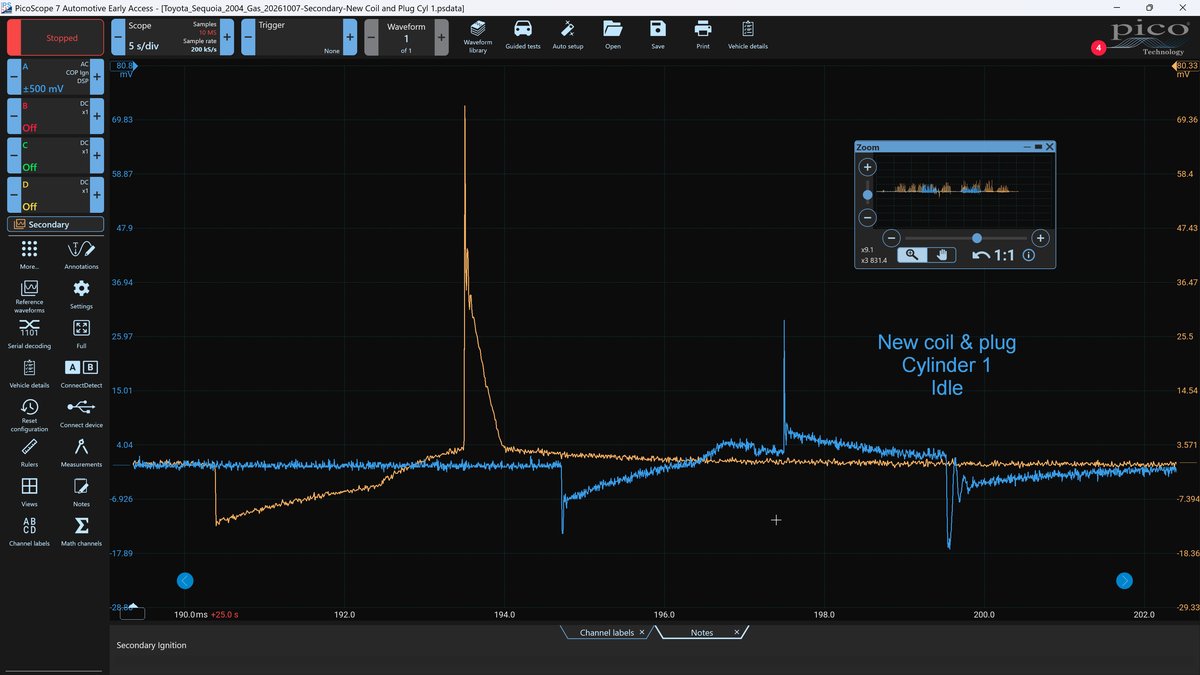
The comparison told the story clearly:
- Yellow trace: secondary voltage leaking outside the combustion chamber. The spark wasn’t doing its job where it should, inside the cylinder.
- Blue trace: a new spark plug and coil on Cylinder 1 at idle, showing proper firing and burn.
Because both patterns sit on the same screen, there’s no ambiguity. The faulty pattern shows the spark escaping, and the repaired pattern shows the spark doing its job. That’s what we mean when we say the scope “pins down the source of the misfire.”
The Fix
Cylinder 1 received a new spark plug and a new coil. The blue trace above was captured after that repair, at idle, and it shows proper firing and burn. In other words, the scope didn’t just find the problem; it confirmed the repair.
Why Testing Beats Guessing
When a misfire shows up, it’s tempting to start replacing parts: plugs today, coils tomorrow, maybe injectors next week. Each guess costs money, and if the guess is wrong, the misfire comes back.
Testing changes that. Our engine diagnostic service uses an oscilloscope to:
- See where the spark is actually going, not just whether a code is set.
- Compare a bad pattern against a good one to confirm the cause.
- Verify the repair before the vehicle leaves the shop.
For you, that means paying for the repair the car actually needs, and driving away knowing it was confirmed with data.
Sequoia Misfire FAQ
Can a misfire be caused by something other than the spark plug?
Yes. In general, misfires can come from ignition, fuel, or mechanical problems. That’s why we test the system instead of assuming the plug is the cause.
What does an oscilloscope show that a code reader doesn’t?
A code reader tells you a cylinder is misfiring. An oscilloscope shows the actual ignition waveform, so we can see how the spark is behaving and where it’s going.
Is it safe to keep driving with a misfire?
It’s best not to wait. A flashing check engine light in particular usually means a severe misfire. Have it diagnosed promptly to avoid further damage.
Book a Misfire Diagnosis in Claremont
If your vehicle misfires, runs rough, or has a check engine light, bring it to Connie & Dick’s Auto Service in Claremont. We test before we replace. Call us today or book online to schedule a diagnosis.
Connie & Dick’s Auto Service · 150 Olive Street, Claremont, CA · 909-626-5653
Related: Check engine light & OBDII diagnostics · Vehicle service · Fuel injection service · Case study: Corvette Opti-Spark diagnosis
Recent Comments